
Private household app / Ongoing experiment
Two Player

in the budget.
The anatomy of
an everyday problem.
I spend a lot of my working life keeping track of moving parts, solving problems and making sure things don't fall through the cracks.
By the time I get home, I simply don't have the mental bandwidth to keep track of everything there, too.
Our tasks, plans, calendars and finances were scattered across different places. I wanted one system that could hold the information and make the connections, rather than leaving them all in my head.
So I started building Two Player. It's a private app for our household, and an ongoing experiment in making something genuinely useful.
The household app is private and not publicly available. All public screenshots and demonstration data are fictional.
The pieces were
in different places.
The challenge with household organisation was that everything affected something else.
A plan for the weekend had implications for the budget. An upcoming expense needed to be considered alongside everything else. A task was only particularly helpful if someone knew it needed doing.
I wanted somewhere we could see the connections and make decisions without having to reconstruct the whole picture each time.
Five views.
One everyday.
Plans reserve room in Money. Admin brings tasks into Today. Wealth takes the longer view.
What needs my attention?
An allowance for the next seven days sits beside the shared week and things that need doing. A starting point, rather than every detail at once.
The shared week, plan allowance and next tasks meet here.

What have I already planned for?
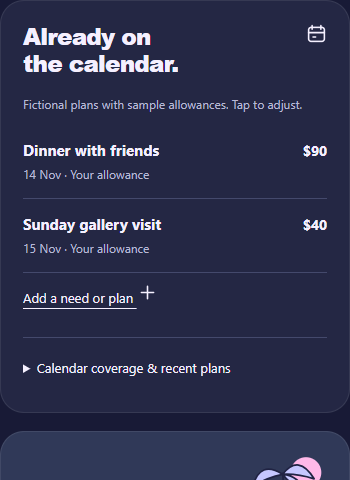
Spending and upcoming payments sit alongside money reserved for active plans. Categorising a sample purchase changes the totals; adding a plan changes the allowance.
Plans reserve an allowance here before the spending happens.

What does the longer view look like?
Recorded assets, cash and debts sit separately from everyday spending. The demo includes adjustable savings and repayment scenarios, using simplified fictional calculations.
Recorded assets and debts give a longer view than the weekly allowance.

What’s coming up?
The shared week, spending plans and time off appear together. A plan can have a date, an allowance and a status. It reserves room in the budget, rather than becoming a forgotten note.
A dated plan appears in the shared week and reserves room in Money.

Who’s on it?
Shared tasks are grouped by what needs attention soon and what can wait. Open a task, take it on or mark it done. One less thing on the list.
Tasks that need attention also surface in Today.
place.
Five tabs.
Start with the question.
Each view answers a question we actually need answered. What matters is that finding the answer doesn't require us to piece together information from three other places.
The challenge is deciding which details need to appear together and which can stay out of the way until they're useful.
Learning by making.
I've spent much of my professional career thinking about how people use systems, how information flows and what makes an experience easier or harder than it needs to be.
Building Two Player has given me an opportunity to apply that thinking in a different context.
It's one thing to have an idea for a useful application. It's quite another to work through the decisions required to make it function.
What belongs on the first screen? What information needs to be connected? How much detail is helpful before it becomes overwhelming?
I keep coming back to the same questions I ask in marketing and operations: Who is this for? What are they actually trying to do? And have I made that easier?
Except this time, I'm also the person trying to build the answer.
Have
a play.
Explore the fictional demoI've made a separate, interactive demonstration so you can explore the idea.
It uses entirely fictional people, finances and household information. You can add a task, create a plan or adjust a financial scenario to see how the different parts work together.
The demonstration is separate from my private household application. It doesn't connect to our information or accounts, and your changes reset when you reload.
Financial scenarios are simplified illustrations, not a validated planning tool.
Could it become
something more?
Two Player started as a solution for my own household, and that's still its primary purpose.
I'm curious whether a version of it could be useful to other households. I haven't tested that idea yet, and what works for us might be completely wrong for someone else.
But I'm interested enough to keep exploring it.
Back to homepage